Hearing loss doesn’t affect everyone the same way. Some people have difficulty hearing higher-pitched sounds, while others struggle with lower-pitched sounds. Low-frequency hearing loss means you have trouble hearing lower-pitched sounds.
There are several potential causes for this kind of hearing loss, and while knowing the type can provide useful information, you can’t identify the underlying cause without a hearing evaluation. Understanding why your hearing has changed matters because it will impact how it’s treated, so if you’re having issues hearing lower-pitched sounds, it’s important to learn why.
What Is Low-Frequency Hearing Loss?
Frequency measures a sound’s pitch. Lower-pitched sounds can include deeper voices, bass notes in music, and certain environmental sounds. If you have low-frequency hearing loss, you will have more difficulty hearing or understanding these sounds than higher-frequencies.
Low-frequency hearing loss means you have less hearing sensitivity for lower frequencies. It is sometimes called reverse-slope hearing loss because of the shape it creates on an audiogram.
This primarily affects one ear but can impact both. It ranges from mild to severe and can occur in conjunction with other types of hearing loss. To test for this kind of hearing loss, you’ll need to go in for an audiogram. The audiologist may do additional audiometric testing to measure your sensitivity across a range of frequencies.
What Does Low-Frequency Hearing Loss Sound Like?
Low-frequency hearing loss can vary from person to person. Because lower frequencies contribute to the overall quality and clarity of voices and sounds, you may notice that speech, particularly deeper voices, doesn’t sound as clear as it once did.
You may notice that:
- Certain voices sound muffled or less clear.
- People may be speaking clearly and loudly, but they’re still difficult to understand.
- Certain low-pitched sounds are less noticeable.
- Music sounds different, particularly when it has a prominent bass.
- Conversations are harder to follow if there’s background noise or you’re on the phone
Someone who can’t hear low frequencies may not necessarily think they have hearing loss. Instead, deeper sounds may seem incomplete, muted, or difficult to distinguish. The degree of hearing loss matters because of how it affects you and your lifestyle.
What Causes Low-Frequency Hearing Loss?
Some of the more common possibilities of reverse slope hearing loss include:
Ménière’s Disease
Ménière’s disease is a condition that affects your inner ear. Recurring low- to medium-frequency hearing loss is a common symptom, along with vertigo, tinnitus, and a feeling of fullness in the ear. While it typically affects only one ear, it can eventually affect both. An audiogram alone cannot diagnose Meniere’s disease.
Genetic or Congenital Factors
Some people are born with decreased hearing or develop it due to genetics. Your family history, when your hearing changed, and other factors can help determine if your hearing loss is genetic. In some cases, inherited hearing loss may affect specific frequency ranges, or it may follow a pattern based on how it runs in your family.
Middle-Ear Conditions
Your middle ear is where your eardrum and eustachian tubes are located. Excess fluid, inflammation, infections, or other middle-ear issues can interfere with how sound transmits, leading to hearing difficulties. An ear examination can help determine whether your hearing problem stems from an issue in your middle ear.
Inner-Ear or Sensorineural Conditions
Damage to your inner ear can cause you to develop low-frequency hearing loss because it’s the part that contains the auditory pathways that carry sound information to your brain. It can affect your ability to hear different frequency ranges, primarily lower ones, making deeper voices and low-pitched sounds less clear or harder to distinguish.
How Is Low-Frequency Hearing Loss Diagnosed?
Diagnosis starts with a hearing evaluation that considers your symptoms, medical history and the pattern of your hearing loss. Your provider may also examine your ears for problems involving the ear canal or middle ear.
Pure-Tone Hearing Testing
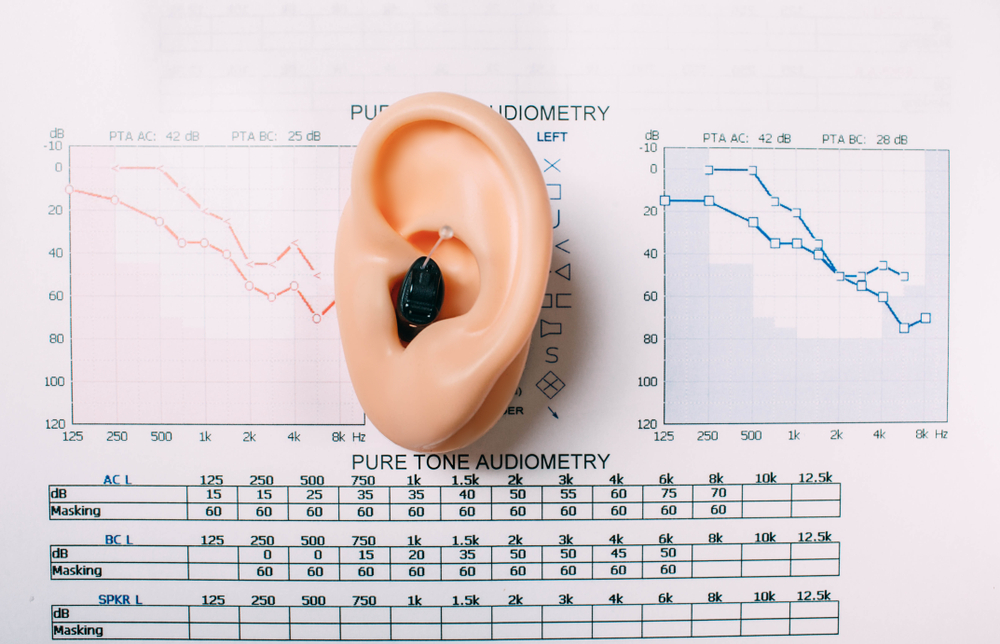
Pure-tone audiometry measures how well you hear different frequencies. The results are plotted on an audiogram, allowing your provider to see whether your hearing is reduced at certain frequencies and if the pattern is different between both ears.
Speech Testing
Speech testing evaluates how well you can hear and understand spoken words. It can show whether low-frequency hearing loss is affecting your ability to understand speech, especially in conversations that involve deeper-pitched voices or background noise.
What Does Low-Frequency Hearing Loss Look Like on an Audiogram?
On an audiogram, frequency is measured in Hertz (Hz) along the horizontal axis, while hearing level is in decibels (dB) along the vertical axis.
With a typical low-frequency hearing loss configuration, the thresholds are poorer at lower frequencies and improve as frequencies get higher. In other words, the graph slopes upward as you go from the lower frequencies to the higher ones.
This is why it’s sometimes called reverse slope hearing loss, because of the general shape of the hearing thresholds.
How Is Low-Frequency Hearing Loss Treated?
Treatment for low-frequency hearing loss depends on the cause and whether the hearing changes are temporary or permanent.
If an underlying ear condition is responsible, treatment may focus on managing that condition. For permanent hearing loss that affects communication, hearing aids may help. Because low-frequency hearing loss affects certain pitches more than others, hearing aids can be programmed to amplify the frequencies you need instead of just making all sounds louder.
For some, treatment may involve a combination of medical care, new hearing technology, and changes to your listening environment, such as reducing background noise or using earplugs in louder settings.
If You Suspect Low-Frequency Hearing Loss, Get Your Hearing Evaluated
Consider scheduling a hearing evaluation if you consistently have trouble hearing certain voices or sounds, especially if it is becoming more noticeable.
Make a hearing test appointment to rule out or diagnose your hearing loss. Make sure you bring up the following things to your audiologist, so they have the full picture of your hearing:
- Deeper voices are harder to understand
- Low-pitched sounds seem muffled or unclear.
- You can hear someone speaking but have trouble understanding them.
- Your hearing seems better for high-pitched sounds.
- Your hearing changes or fluctuates.
Take the Next Step When Your Hearing Changes
Noticing that certain voices, sounds, or conversations have become harder to follow is a reason to get your hearing checked even if you can still hear most everyday sounds normally. Low-frequency hearing loss can be subtle, and its cause isn’t always apparent from the symptoms alone.
A hearing evaluation can identify which frequencies you’re struggling with and give your audiologist a clearer picture of your hearing so they can determine if continued monitoring, medical evaluation, hearing aids, or another approach makes sense to help you regain your hearing.
Beltone Skoric provides hearing evaluations for Michigan residents at any of our hearing aid centers and can help you get to the bottom of your hearing concerns.